
This page outlines the primary material groupings within The Kitty Arnold Pittman Collection, organized to document early twentieth-century door-to-door subscription book sales and distribution.
The collection is anchored by two original publisher-issued sales agent sample kits, supported by representative bound volumes and contemporaneous sales-agent and commercial documents. Together, these materials preserve evidence of how subscription titles were presented, priced, ordered, fulfilled, and used within American households.
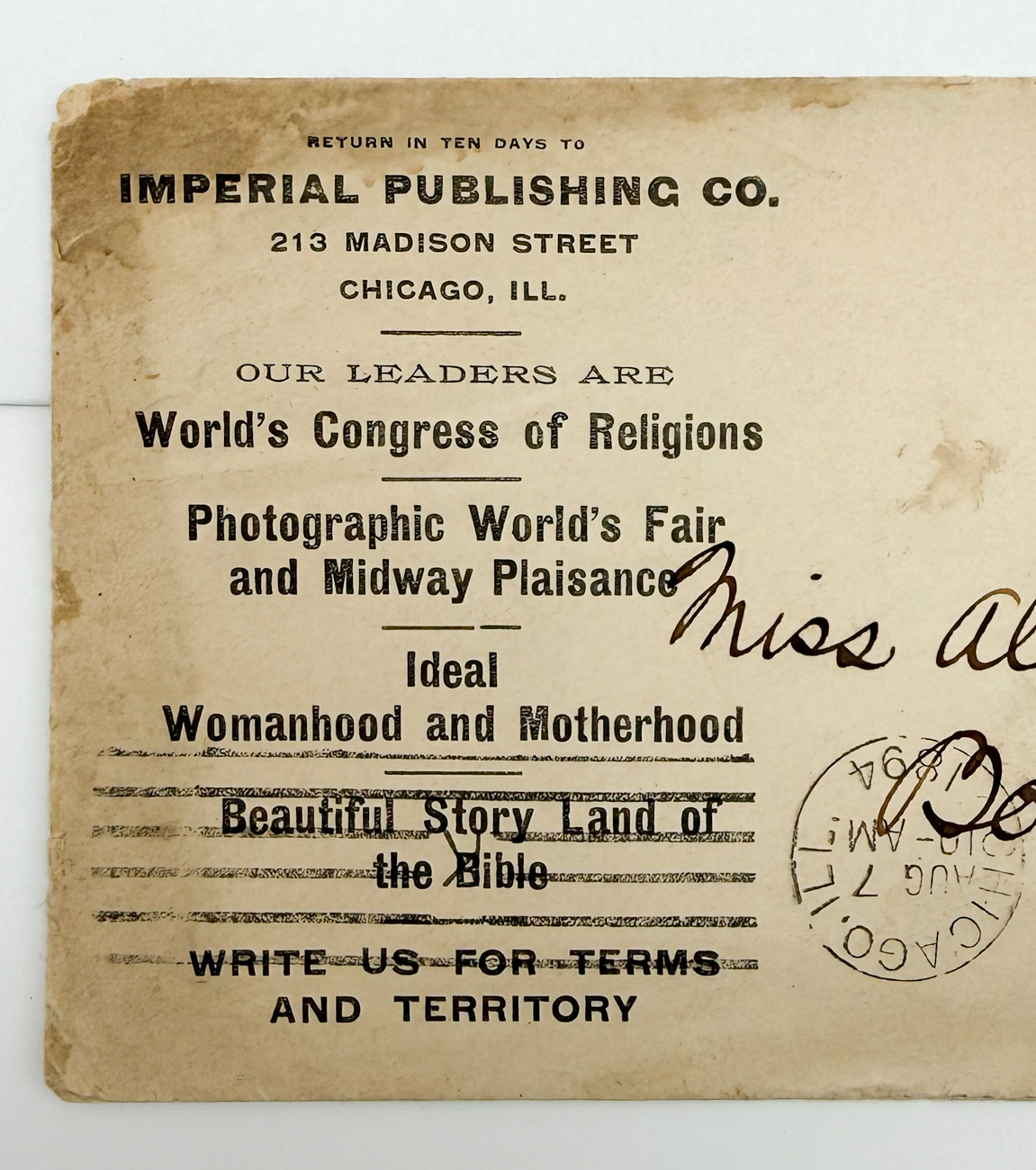
Representative of the Chicago-based door-to-door subscription publishing ecosystem contemporaneous with the books and sales materials in the collection. (1 item)
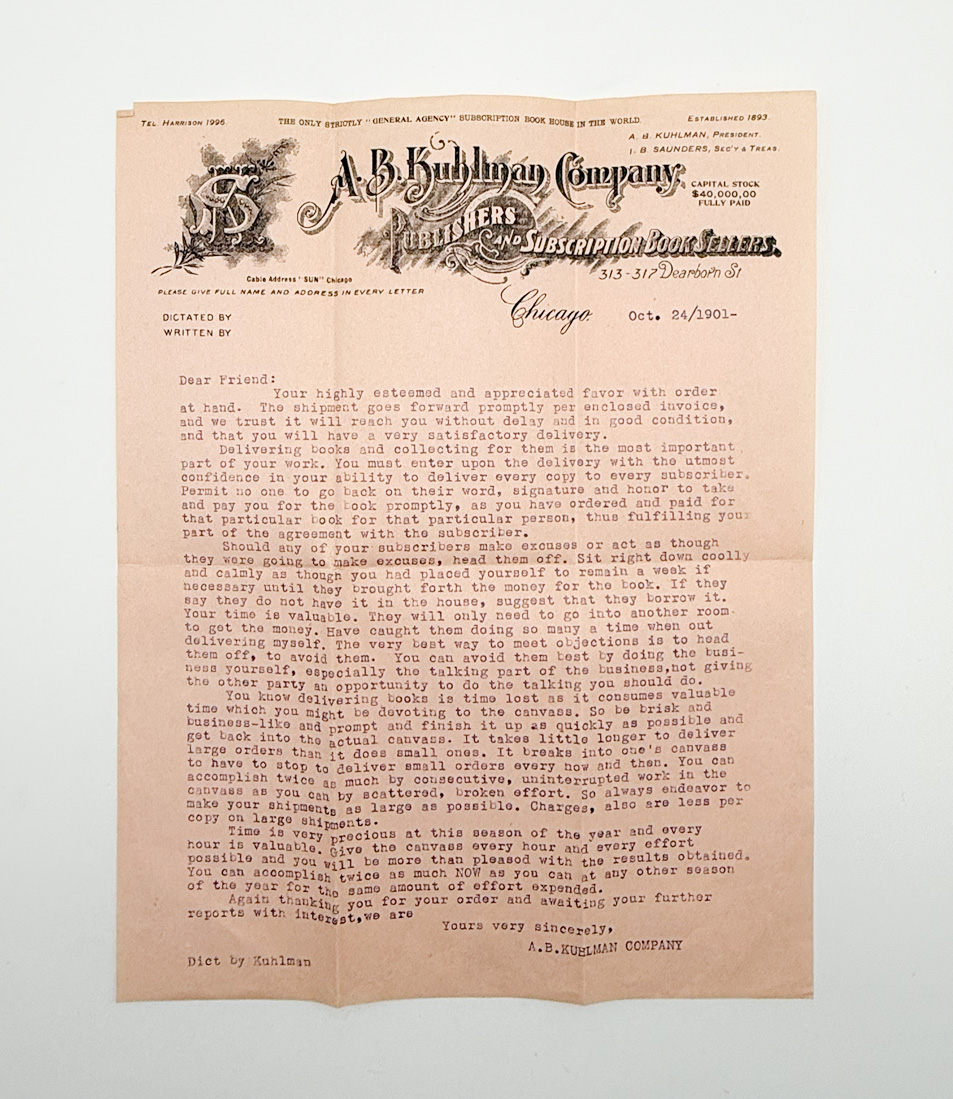
Retained as an intact sales-agent correspondence group documenting subscription-publishing operations, agent training, order processing, payment, and freight fulfillment practices of AB Kuhlman Company in 1901. (8 items)
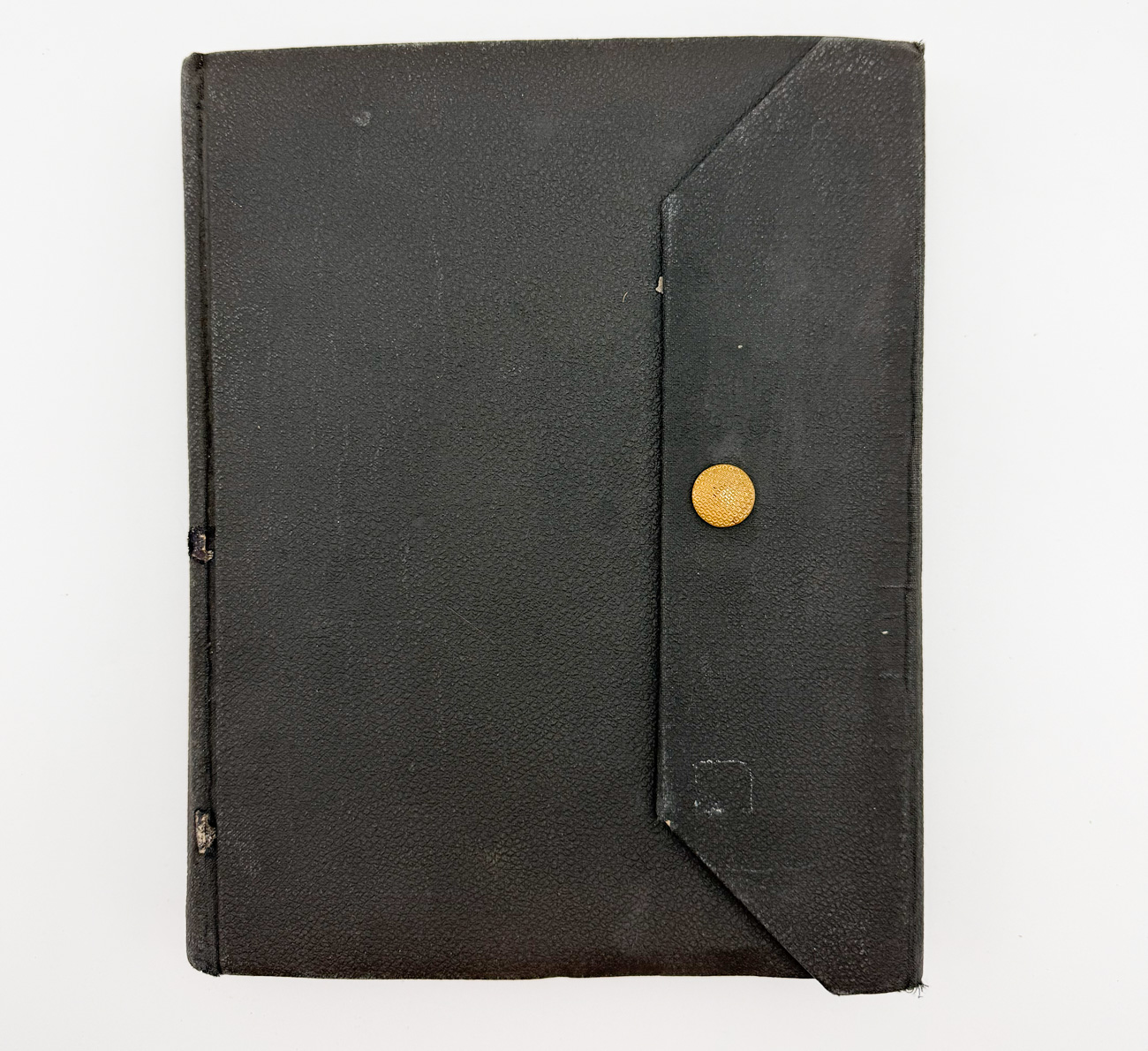
Door-to-door sales kit used by A.B. Kuhlman and Morse & Co. sales agents to present titles, pricing, and ordering information to families. Includes sample materials for titles represented elsewhere in the collection. (2 kits)
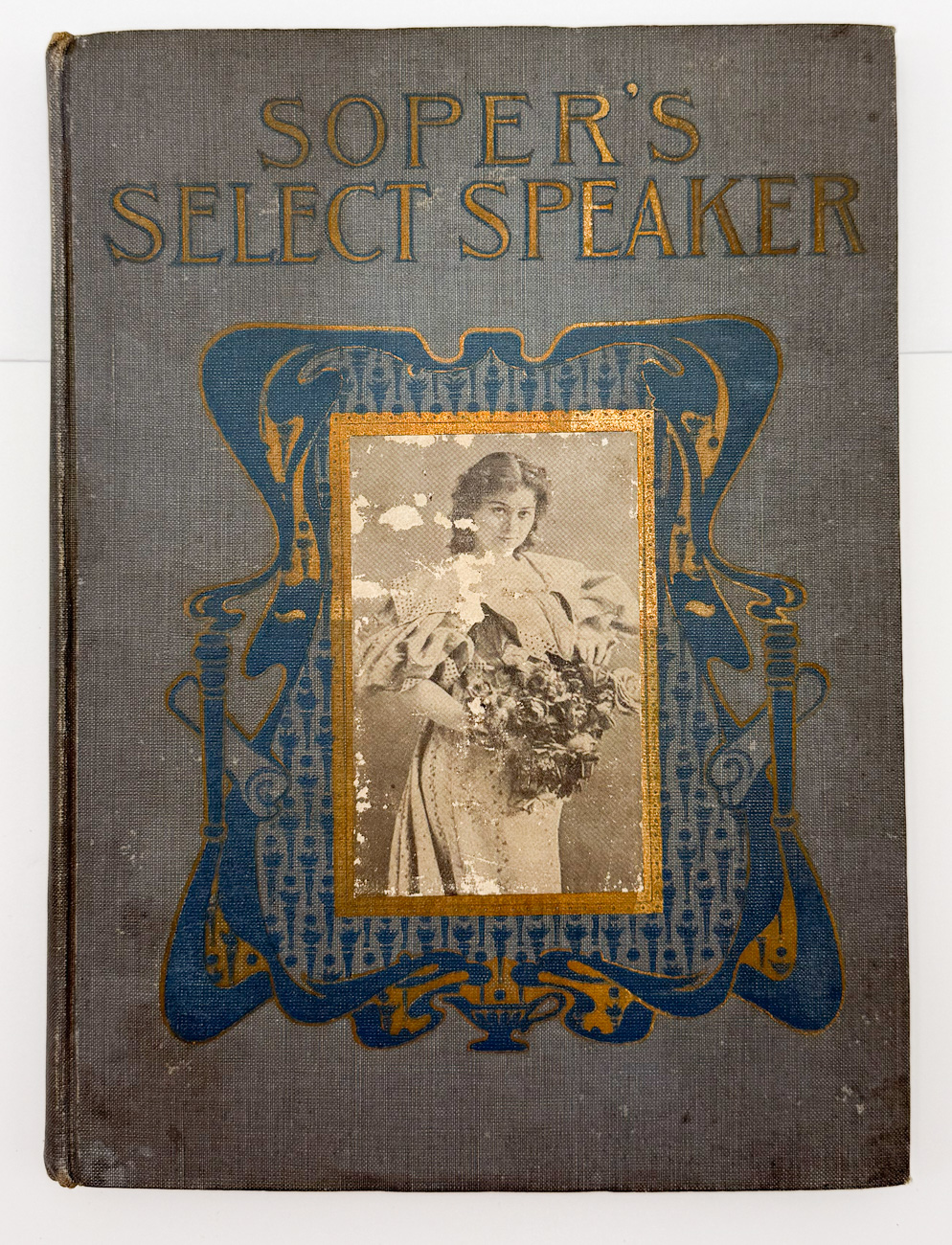
Abridged salesman’s sample editions with reduced interior content and full table of contents referencing the complete volume; pricing and marketing information printed on rear pages, followed by multiple clean, ruled ledger pages intended for sales-agent notetaking. (2 samples: Soper's Select Speaker and Social Culture)
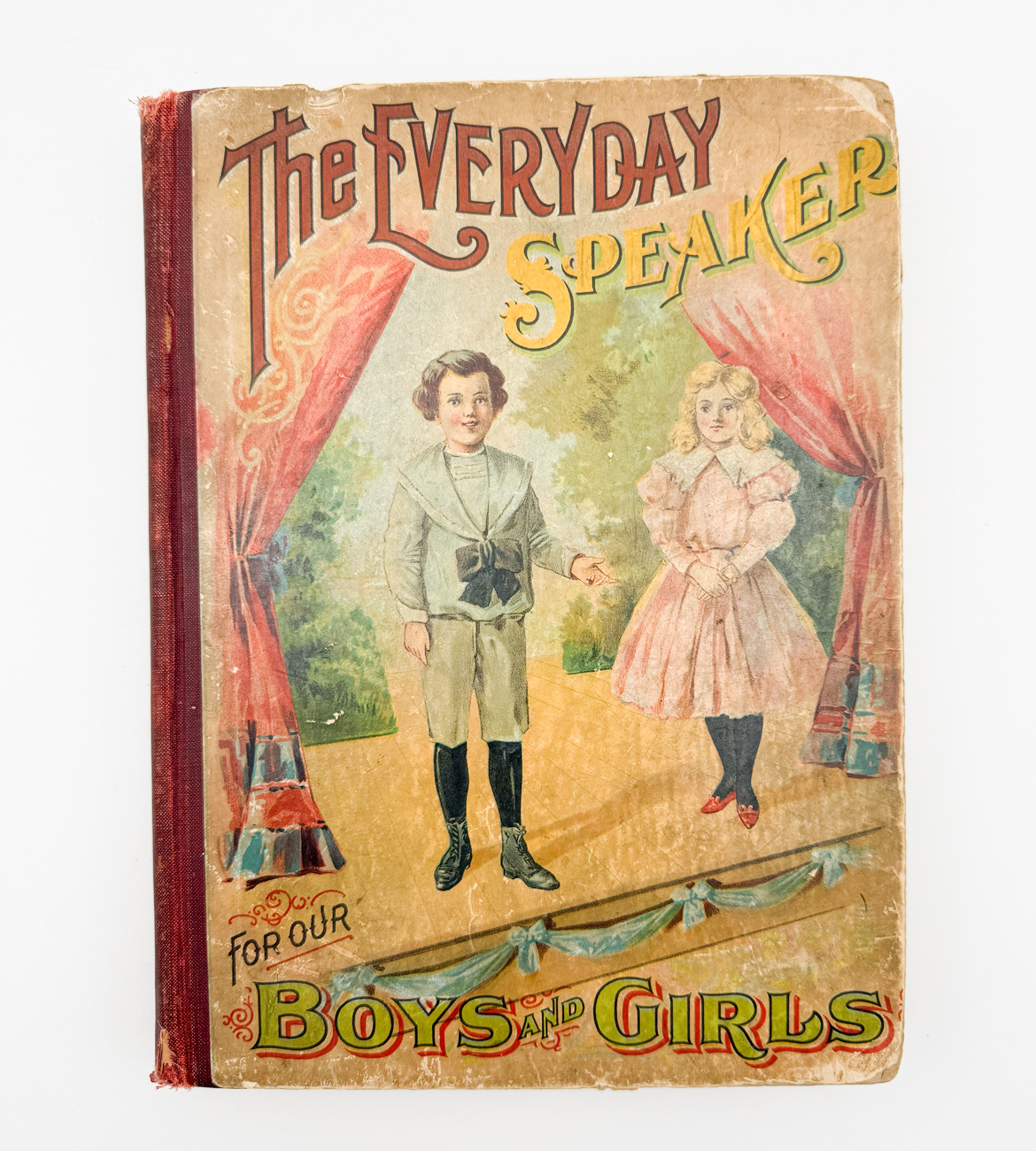
Sold volumes as delivered to buyers, some containing data/geo inscriptions and retained period ephemera. (23 books)
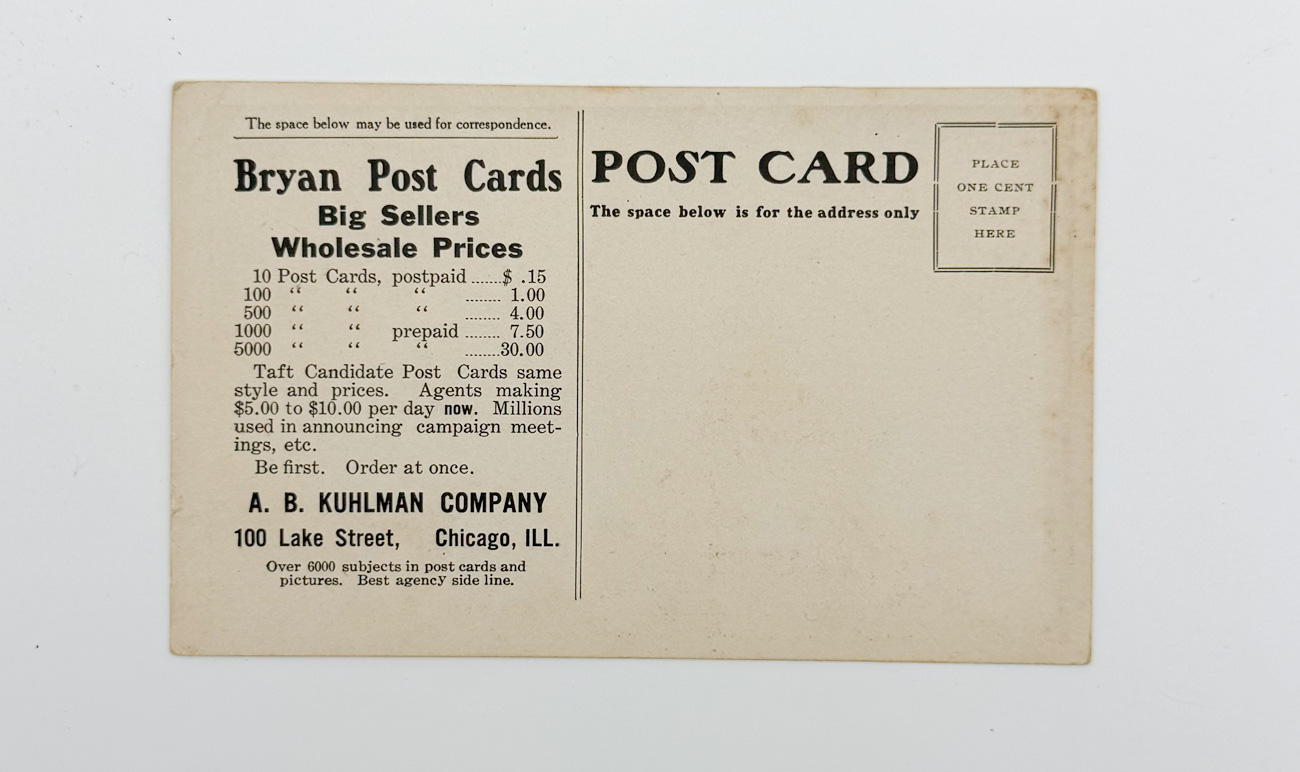
Sideline product that llustrates diversification of subscription-publishing sales networks into political and topical merchandise, demonstrating the breadth of products marketed through AB Kuhlman Company’s agent-based distribution system. (1 item)
Attributed to EC Morse & Company of Chicago, Sales Kit 1 is a well-preserved door-to-door sales agent’s sample kit used to present subscription book offerings to families during in-home sales visits. The kit functioned as a sales presentation and ordering instrument, not as a container for finished volumes.
The kit contains multiple sample bindings with simulated spine thickness, designed to demonstrate the appearance and scale of finished books. Inlaid photogravure plates, descriptive presentation materials, and a complete, double-sided pricing sheet support structured in-home sales presentation.
At the rear of the kit are unused ruled ledger pages intended for sales-agent note-taking and order capture. Color, gilt, and printed elements throughout remain vibrant, indicating exceptional preservation and minimal field use.
Sales materials within the kit reference the following titles, all of which are represented elsewhere in the collection as finished volumes:
My Mother’s Life of Jesus
Famous Fairy Tales
Poems That Never Die
Soper’s Select Speaker
The kit demonstrates how publishers standardized the presentation of multiple titles within a single household-oriented sales framework.
Standardized door-to-door sales presentation practices
Visual strategies for representing finished books through sample bindings and plates
Fixed pricing structures and ordering mechanics
Sales-agent workflow, including customer note-taking and order documentation
The relationship between sales presentation materials and corresponding finished volumes
Attributed to AB Kuhlman Company of Chicago, Sales Kit 2 is a second door-to-door sales agent’s sample kit used to present subscription book offerings to families during in-home sales visits. Like Sales Kit 1, it functioned as a sales presentation and ordering instrument, not as a container for finished volumes.
The kit contains multiple sample bindings with simulated spine thickness, designed to demonstrate the appearance and scale of finished books. Inlaid photogravure plates, descriptive presentation materials, and a complete, double-sided pricing sheet support structured in-home sales presentation.
This kit includes active ledger entries documenting customer names, titles purchased, prices paid, and binding selections. These entries provide direct, primary evidence of door-to-door subscription sales in practice and offer rare visibility into transaction-level details.
Sales materials within the kit reference the following titles, all of which are represented elsewhere in the collection as finished volumes:
Famous Fairy Tales
Stories of Travel
Social Culture
The Everyday Speaker
Famous Fairy Tales appears in both Sales Kit 1 and Sales Kit 2, reflecting its inclusion across subscription offerings.
Standardized door-to-door sales presentation practices and ordering mechanics
Transaction-level evidence of sales activity through recorded ledger entries
Pricing and binding selection options captured during in-home sales visits
The relationship between sales presentation materials, orders recorded by agents, and corresponding finished volumes
The collection includes representative bound volumes corresponding to the titles presented in the sales kits, along with limited sales-copy materials where applicable. The book copies range from well-preserved to heavily used and contain inscriptions, retained ephemera, bookmarks, and other evidence of repeated handling. Together, these physical traces document how subscription-purchased books functioned within households across decades and enable comparative study across editions, condition states, and patterns of domestic use, including literacy development, devotion, and moral instruction across generations.
The bound volumes in the collection originate from multiple Chicago-based publishers and printers, reflecting a shared reliance on the same door-to-door subscription sales model. This publisher diversity demonstrates how competing organizations operated within a common commercial framework, using similar sales structures, presentation methods, and fulfillment practices rather than firm-specific approaches. The presence of parallel title offerings and comparable production formats across different publishers underscores the extent to which subscription publishing functioned as a standardized business system in early twentieth-century Chicago.
Across the finished volumes in the collection, inscriptions are common and often include dates, names, and presentation contexts. These markings, along with retained ephemera, wear patterns, and binding variations, provide evidence of how subscription-purchased books entered households, were retained, and were reused across time.
The combination of sales-copy materials and finished volumes allows for comparative analysis between how titles were presented for sale and how they ultimately functioned within domestic settings.
All volumes and sales-copy materials have been cataloged with attention to title representation, copy count, condition, and contextual linkage to corresponding sales kits and sales-agent documentation. Additional inventories and supporting documentation are available upon request.
My Mother’s Life of Jesus
Thirteen finished volumes.
No sales copy present.
Most copies bear inscriptions that include names, dates, and geographic identifiers, documenting domestic circulation across multiple locations. These inscriptions provide consistent evidence of household acquisition and use within identifiable communities rather than anonymous ownership.
One copy includes an inscription dated 1906 documenting presentation as a gift to a young girl; a later inscription records the same volume being regifted in the 1970s to the original recipient’s granddaughter at approximately seven years of age, providing direct evidence of multi-generational household retention and reuse. Another copy includes an inscription identifying the recipient as a resident of the Bennings neighborhood of Washington, DC, illustrating the geographic specificity commonly present across the collection’s inscriptions.
Famous Fairy Tales
Two finished volumes.
No sales copy present.
Inscription evidence is present.
Soper’s Select Speaker
Two finished volumes plus one sales-copy representation.
Three total representations of this title.
The presence of both finished volumes and sales copy supports comparative study of sales presentation versus fulfilled product.
Poems That Never Die
Two finished volumes.
No sales copy present.
One copy serves as a “hero” example, containing more than two dozen pieces of in situ Edwardian ephemera retained within the volume. The second copy contains handwritten automobile sale notes referencing a 1926 Packard sedan and a 1934 Oldsmobile sedan, providing extensive evidence of long-term domestic use.
Stories of Travel
Three finished volumes.
No sales copy present.
Inscription evidence is present.
Social Culture
One sales-copy representation only.
No finished bound volume present.
This title is represented solely through sales materials, offering insight into marketed offerings independent of fulfillment.
The Everyday Speaker
One finished volume.
No sales copy present.
Inscription evidence is present.
Supplementing the sales kits and bound volumes are contemporaneous sales-agent and commercial documents associated with Chicago-based subscription publishing and distribution.
Materials include envelopes, correspondence, order forms, freight instructions, invoices, and seasonal sales directives. These artifacts document the operational mechanics of subscription publishing, including agent coordination, fulfillment logistics, and publisher oversight.
Taken together, the materials in the Kitty Arnold Pittman Collection document the full subscription book sales lifecycle, including:
Publisher recruitment of door-to-door sales agents, evidenced through mailed recruitment materials and correspondence
Sales-agent motivation and retention efforts, documented through correspondence encouraging persistence, confidence, and continued sales activity, with repeated emphasis on earning potential
Publisher development of title offerings and standardized sales materials
Sales-agent presentation structure and in-home order capture
Pricing, binding selection, and fulfillment processes
Delivery of finished volumes to households
Long-term domestic use and retention within families
The collection is organized to preserve these relationships, supporting study of subscription publishing as a commercial, educational, and cultural system rather than as a genre-based book archive.
All materials have been cataloged with attention to provenance, condition, and contextual linkage between sales materials and corresponding finished volumes. Additional inventories, images, and supporting documentation are available to institutional reviewers upon request.